- Best for
- Exceptional elephant encounters with occasional lion sightings · Large elephant families and bulls · Kilimanjaro as a dramatic backdrop · Vast open landscapes · Spectacular photo opportunities · Perfect slower-pace complement to Masai Mara
- Best months
- June to October · January and February
- Ideal duration
- 3 to 4 nights
- Getting there
- Via Nairobi, with road or scheduled light-aircraft access depending on itinerary
Introducing Amboseli
Where elephants eclipse a volcano.
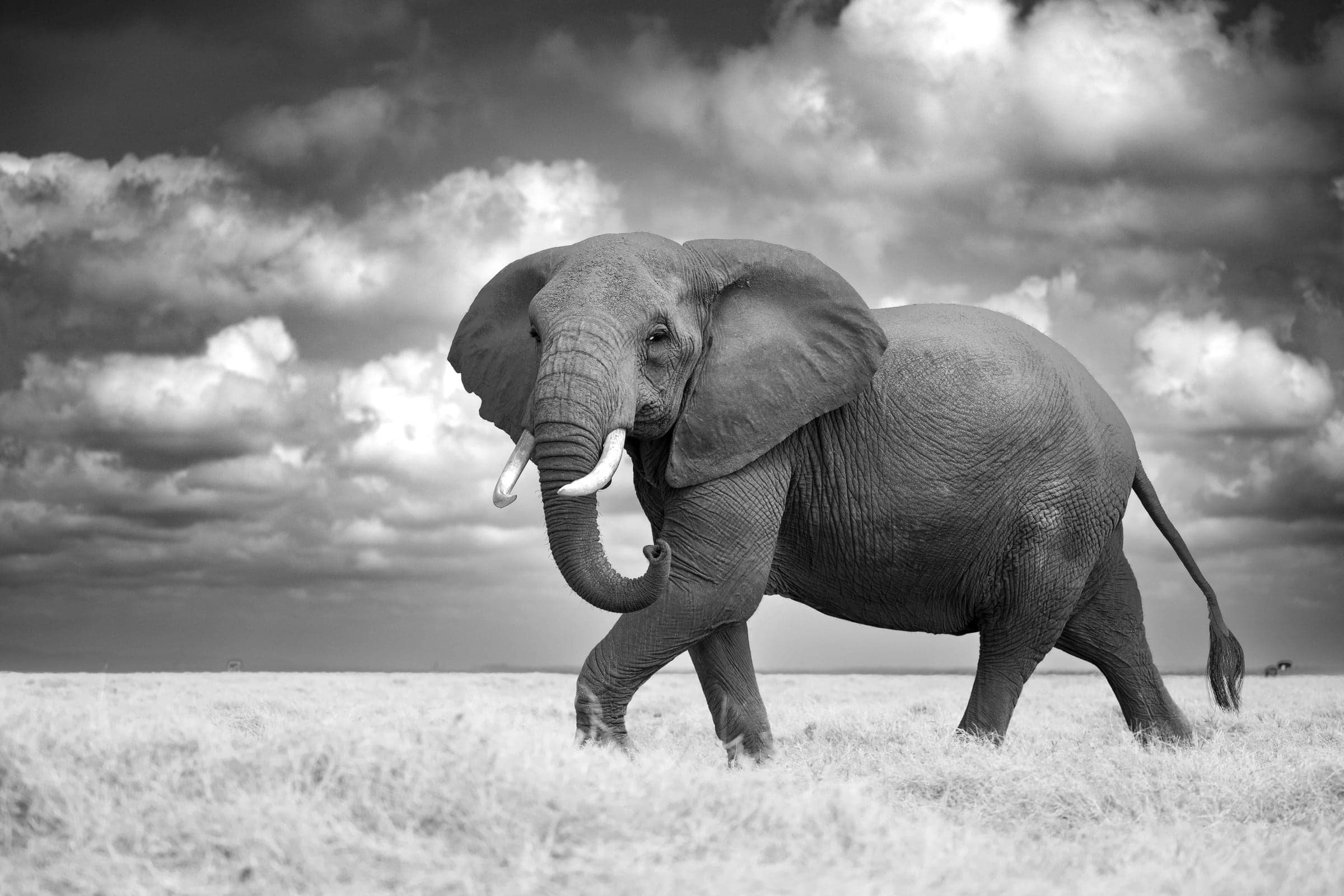
Amboseli is synonymous with African elephants. It is a place to watch them move through a vast landscape, with the majestic Mount Kilimanjaro rising beyond the grassy plains; a picture postcard come to life, sending an implacable delight coursing through your veins.
Massive herds of elephants move across its plains. The backdrop is the mighty Kilimanjaro, Africa’s famous highest, volcanic peak, sometimes snow-capped, sometimes bare and sometimes cloud-cloaked, but always present, rising abruptly like a bridge to the beyond. But even the mountain takes backstage to the pachyderms on their perpetual peregrinations between the swamps and the grasslands like children of a giant in whose shadow they are not eclipsed but in fact accentuated to a nicety.
Field notes
Three ways to readAmboseli.
A concise field guide to the landscape, its daily rhythm and the encounters that define it.
The landscape
“A salty and dusty place”
‘Amboseli’ is derived from empusel, the Maasai word for a salty, dusty place. And that is an excellent point from which to start understanding Amboseli. Its scenic environs are constructed by the eponymous dry lakebed, Lake Amboseli, whose ash-like, alkaline soil becomes the tiled earth on which elephants sojourn to their feeding pastures every day. For across the…
Photo journal
Amboseli,in frames.
Open any photograph to explore the collection in full screen.
Destination combinations
Better together.
Considered routes that place Amboseli in a wider journey without rushing either landscape.
 01
01 02
02Masai Mara, Amboseli, Lake Nakuru & Naivasha
A grand tour of southern Kenya for the history books.
Start planningYour private journey
Make your own Amboseli plan.
Tell us what draws you here. We will shape the right season, access, pace and places into one coherent private journey.
Begin planningGood to know
Question, meet answer.
Is Amboseli worth visiting for elephants?
Absolutely! Amboseli is particularly well known for its elephants. Its open landscape makes it possible for you to observe and photograph the pachyderms with hardly any visual obstruction. The combination of elephant behaviour, expansive plains and the Kilimanjaro mountain gives this destination a character that is difficult to replicate elsewhere.
How many nights should I spend in Amboseli?
Three nights is a good starting point for a focused Amboseli safari – the minimum. Four nights allows more flexibility for wildlife photography and slower mornings, and works especially well if Amboseli forms part of a longer Kenya itinerary.
Can I always see Mount Kilimanjaro?
No. The mountain is frequently affected by clouds and local weather. We would never promise a clear view. But we can assure you that the landscape and wildlife continue to be hauntingly beautiful and compelling for photography when the summit is hidden, too.
Is Amboseli good for wildlife photography?
Very much so! Its open terrain, elephant herds, dramatic skies and potential Kilimanjaro backdrop create excellent conditions for both environmental wildlife images and intimate animal portraits.