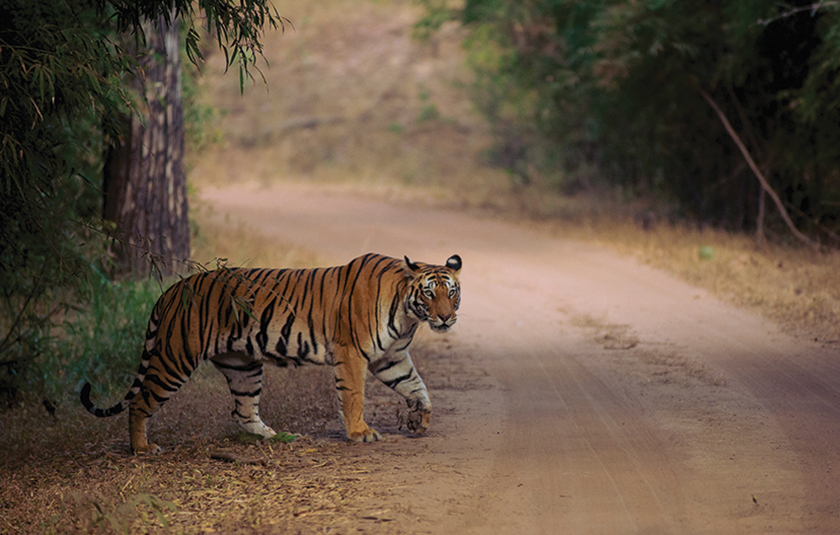
Bandhavgarh is memory etched into a landscape of sal forest, open meadow, ancient stone and tiger country.
Bandhavgarh National Park, in Madhya Pradesh, is not merely a forest. It is memory etched into the landscape itself. It carries the scent of damp sal leaves after the first rain, the hush before dawn breaks over open meadows, and the steady hum of bees through a blazing summer noon. Each moment here becomes a sensory imprint, bringing back the forest to you long after you have left. This land feels older than time itself. Legends do not sit lightly here; they breathe through stone and root. For centuries, the tiger has ruled these forests with quiet authority, shaping their rhythms and silences. There is a sense of stepping into an ancient kingdom where the monarch still walks unseen, yet undeniably present.
At the heart of this wilderness rises the formidable Bandhavgarh Fort. Nearly two thousand years old, it stands as a patient sentinel above the forest. Thirty two hills ripple outward, cloaked in forest and bound together by winding game trails. The name itself carries myth. Bandhavgarh, the brother’s fort. It is believed that Lord Ram entrusted this stronghold to Lakshman as a symbol of devotion and duty. Whether taken as history or legend, the ruins hold a palpable weight of antiquity. Folklore also speaks of the Gond rulers who once guarded these forests, long before modern boundaries defined them. Their presence lingers in weathered sculptures and forgotten pathways reclaimed by vines.
Yet it is the living forest below that defines Bandhavgarh. The landscape shifts with every turn. Open grasslands glow gold under the afternoon sun. Bamboo thickets murmur softly in the wind. Tall sal forests rise in cathedral like stillness. Each habitat carries its own pulse, its own quiet intensity. Seasons repaint this canvas year after year, yet its essence remains unchanged. Bandhavgarh supports extraordinary diversity. Herds of chital move across meadows, as. Langurs keep watch from treetops. Crested serpent eagles circle overhead. More than thirty species of mammals, hundreds of bird species, and an immense variety of plant life coexist in delicate equilibrium.
The intricate web of life reveals itself to those who pause long enough to observe. Above all, it is the tiger that defines Bandhavgarh’s legend. Names such as Charger, known for his bold dominance, Sita, whose lineage shaped generations, and later B2 and Bamera, became part of the park’s living history. They were more than sightings; they were presences that shaped territories and narratives. From the sweeping expanse of Chakradhara, framed by the watchful presence of the ancient fort, to the dappled sanctuary of Andhiyari Jhiriya where a quiet stream gurgles through the forest floor, lending the landscape a meditative calm, Bandhavgarh unfolds in shifting moods and textures.
From the legendary basin of Sukhi Pathiya to the dense bamboo stretches of Khitouli, tigers command remarkably varied terrain. Each zone carries its own character, its own light and rhythm, yet across these contrasting landscapes the tiger remains the undisputed sovereign. Photographers and naturalists from across the world thronged here, captivated by the possibility of witnessing these magnificent cats in their realm. Bandhavgarh emerged as one of the most celebrated tiger landscapes on the planet. Cubs grow into powerful adults, establish dominion, and eventually yield to new bloodlines. The forest absorbs each story into its continuing chronicle. What stands out most is the continuity.
The fort endures, softened by time and creepers. Human kingdoms have faded. Villages once scattered across the forest have relocated, allowing the land to regenerate. Through every change, the tiger remains. Bandhavgarh is not simply a national park. It is a testament to resilience, where mythology, history and conservation intertwine. It reflects nature’s capacity to reclaim and restore when granted space and protection. When the distant call of a sambar echoes through the trees, anticipation returns instantly. In Bandhavgarh, the Royal Bengal Tiger does not merely survive. It reigns. And high above, the ancient fort continues its silent vigil over a kingdom that still belongs to the wild
In Bandhavgarh, the Royal Bengal tiger does not merely survive. It reigns.
Safari Crafters archive