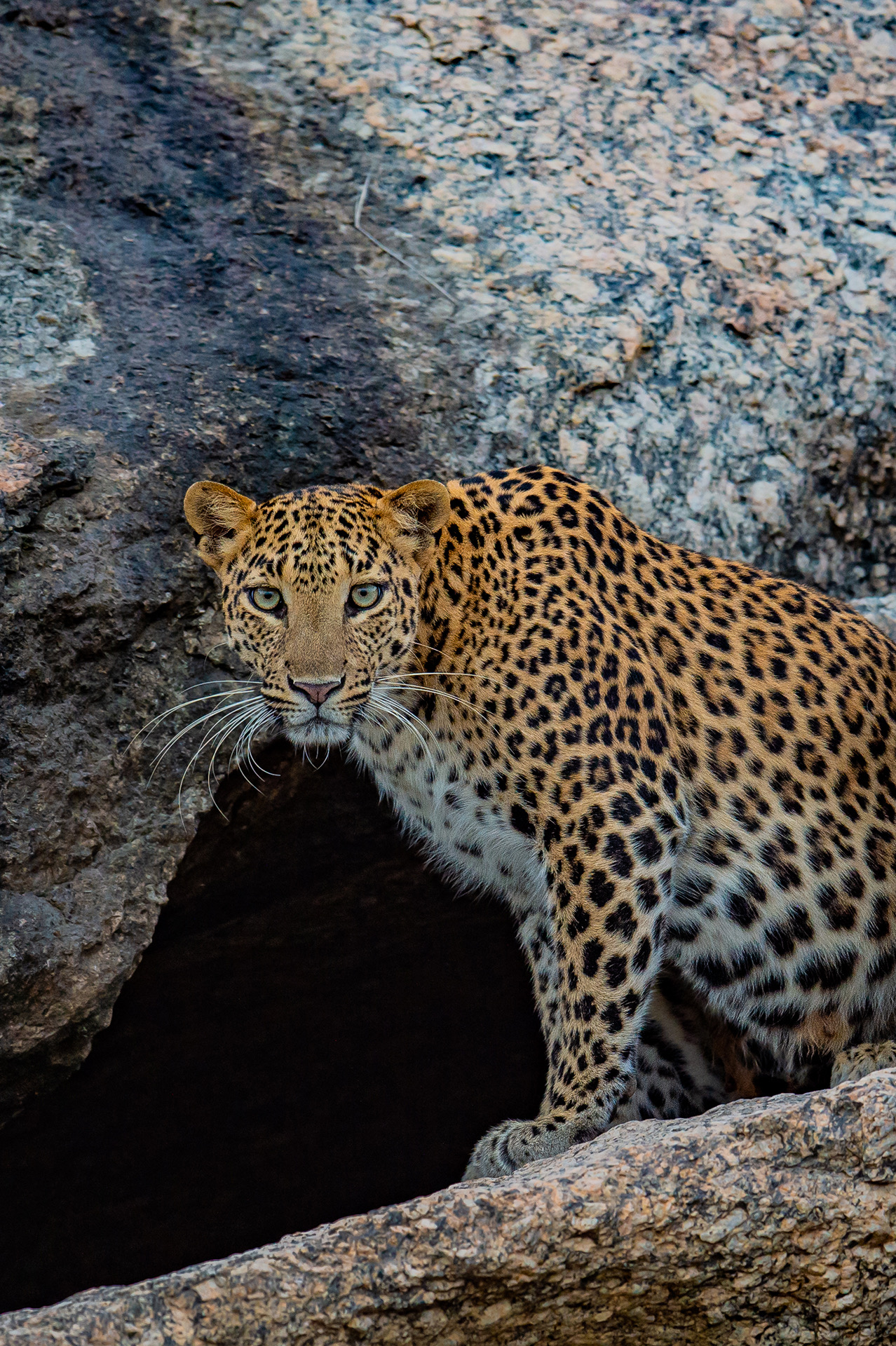
Laikipia's black leopard story belongs to a wider landscape of conservancies, local knowledge and patient night-time fieldcraft.
Laikipia has, in recent years, found its way into global conversation for a rare and elusive presence. The black leopard. But before we speak of her, it is worth understanding the land that allows such a story to exist at all. Set in central Kenya, Laikipia stretches across a high plateau, framed by the slopes of Mount Kenya to the southeast and the drier northern rangelands that lead toward Samburu. It is a landscape that does not overwhelm you immediately. It reveals itself gradually. Mornings are soft and diffused, afternoons carry a harsher clarity, and by evening the land settles into a quiet that feels almost deliberate. What sets Laikipia apart is not just its beauty, but its structure.
This is not a national park in the conventional sense. There are no clearly defined gates or boundaries separating wildlife from human life. Instead, it is a mosaic of private ranches, community lands, and conservancies. Livestock and wildlife move across the same terrain. Samburu and Maasai pastoralists continue traditions that have long shaped this ecosystem, sharing space with elephants, predators, and plains game. Historically, this coexistence has not been without strain. During the colonial period, large tracts of land were converted into ranches, and wildlife movement was increasingly restricted.
In the decades since, however, Laikipia has evolved into one of Africa’s more progressive conservation models. Many of these ranches have transitioned into conservancies, often in partnership with local communities. The result is a working landscape where conservation and livelihoods are closely linked. Today, Laikipia supports significant populations of wildlife, including elephants, endangered Grevy’s zebra, African wild dogs, and a healthy density of large predators. It is also one of the few places in Kenya where wildlife thrives outside formally designated national parks at this scale.
The Black Leopard of Laikipia: There are few wildlife sightings that carry the same quiet anticipation as that of a black leopard. Not because it is impossible, but because it is never guaranteed. Black leopards are not a separate species. They are leopards with melanism, a genetic trait that results in an excess of dark pigmentation. In the right light, their rosettes are still visible beneath the dark coat. While melanistic leopards are more commonly reported in parts of Asia, confirmed sightings in Africa have historically been rare. Laikipia changed that narrative. In 2019, a melanistic leopard was scientifically documented in Laikipia, one of the first confirmed records in Africa in over a century.
Since then, sightings have continued intermittently in certain conservancies, drawing attention from naturalists, photographers, and travellers alike. Today, the Black Leopard is referred as Giza, a name often associated with the phrase “Giza Mrembo,” loosely translating to “beautiful darkness” in Swahili. It is important to understand that this is not a guaranteed sighting or a fixed character in the landscape. Like any wild animal, she moves on her own terms, across a range that is not defined for visitors. Tracking her is less about pursuit and more about patience. Game drives in Laikipia tend to reflect this approach. There is less urgency, fewer vehicles, and a greater emphasis on reading the land.
You spend time understanding tracks, listening to alarm calls, and observing patterns rather than chasing sightings. On rare occasions, everything aligns. And when it does, the encounter feels unfiltered and deeply personal. A Landscape That Looks Forward What makes Laikipia significant today goes beyond any single species. It represents a model of conservation that is evolving in real time. One that recognises that wildlife cannot exist in isolation from people. Community conservancies, sustainable tourism, and responsible land management all play a role here. The balance is not perfect, and challenges remain, but it is a system that continues to adapt..
You are stepping into a lived landscape where nature and people are constantly negotiating space. And somewhere within it, a dark, elusive presence has quietly taken centre stage. You do not follow it. You wait for it. And if it chooses to reveal itself, even briefly, the moment lingers long after it has passed. Welcome to Laikipia
You do not follow it. You wait for it.
Safari Crafters archive