- Best for
- Bird photography · Wetland ecology · Golden Triangle extension
- Best months
- Winter for large congregations of migratory waterfowl; water conditions and seasonal bird movement should guide exact dates
- Ideal duration
- 2-3 nights, with additional mornings for specialist bird photography
- Getting there
- Agra is approximately 50 km away; Delhi and Jaipur can be incorporated into a wider private road route
Introducing Bharatpur & Keoladeo
A landscape with no need to perform.
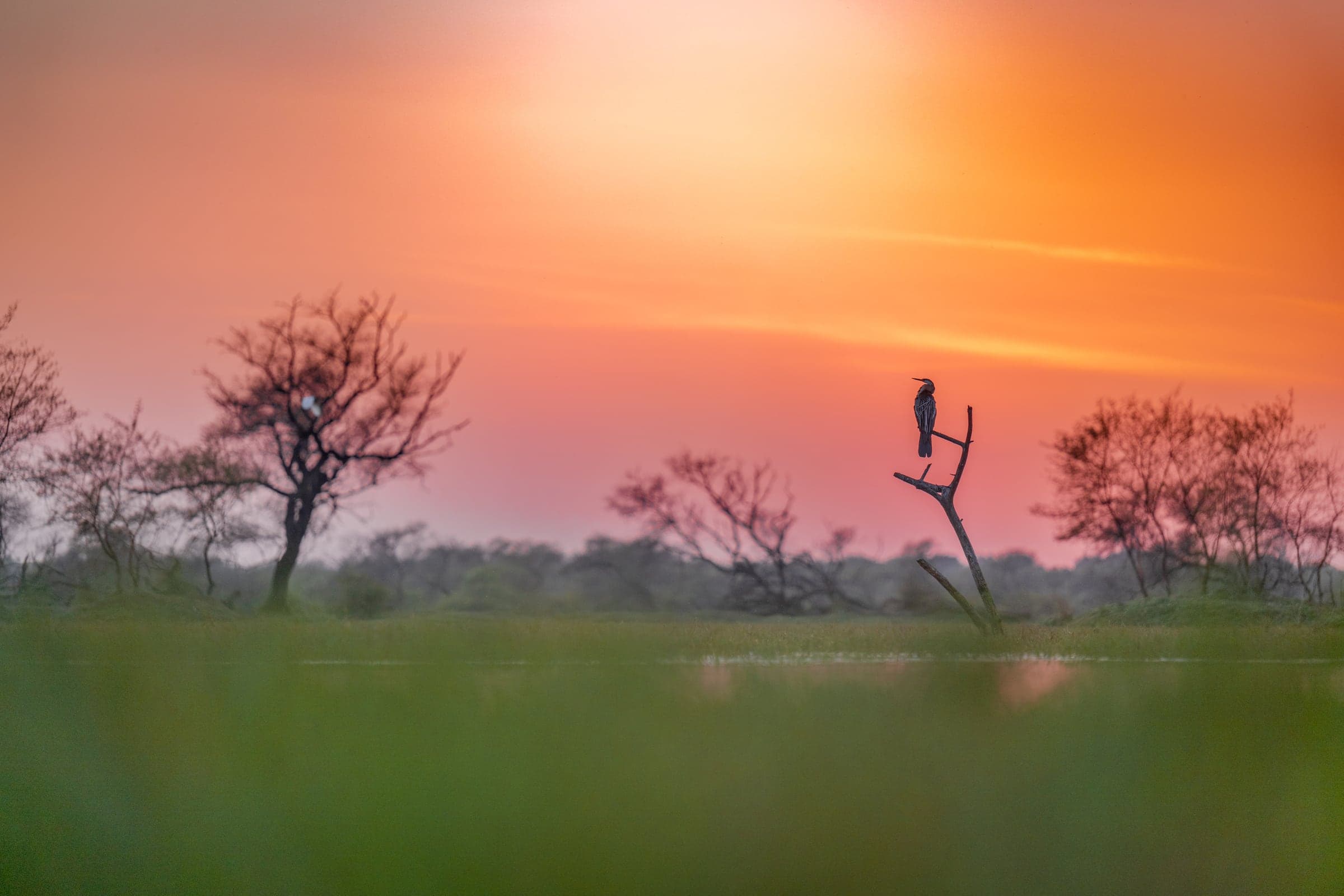
In the eastern reaches of Rajasthan, a place of remarkable serenity and ecological harmony, lies Keoladeo National Park. Universally known as Bharatpur, this park is celebrated as one of the world's most vital avian landscapes. Here, water, grass, and sky converge in delicate equilibrium to create a peaceful haven. Bharatpur is a chorus of symphonic avian wonders, where the very rhythm of life, shaped by migration, nesting, and breeding, is dictated by the arrival of the seasons on wings. It is, truly, a love letter to peace.
Keoladeo’s origins are as remarkable as its present. Created in the 18th century by the Maharajas of Bharatpur through the damming of local rivers, the wetland was initially designed for flood control and royal hunting. Over time, careful protection transformed it from a duck-shooting reserve into a sanctuary, later earning national park status and, in 1985, recognition as a UNESCO World Heritage Site. Today, Keoladeo stands as a global benchmark for wetland conservation. Its shallow marshes, seasonally flooded grasslands, mudflats, and wooded patches support an extraordinary diversity of birds,both resident and migratory. More than 370 species have been recorded here, making it one of Asia’s most important heronries and wintering grounds for waterfowl arriving from Central Asia, Siberia, Europe, and beyond.
Field notes
Three ways to readBharatpur & Keoladeo.
A concise field guide to the landscape, its daily rhythm and the encounters that define it.
The landscape
Bharatpur & Keoladeo, read slowly.
Managed freshwater wetland, flooded grassland, woodland, swamp and open water
Photo journal
Bharatpur & Keoladeo,in frames.
Open any photograph to explore the collection in full screen.
Your private journey
Make your own Bharatpur & Keoladeo plan.
Tell us what draws you here. We will shape the right season, access, pace and places into one coherent private journey.
Begin planningGood to know
Question, meet answer.
When is the best time to visit Bharatpur & Keoladeo?
Winter for large congregations of migratory waterfowl; water conditions and seasonal bird movement should guide exact dates
How long should I stay in Bharatpur & Keoladeo?
2-3 nights, with additional mornings for specialist bird photography
What wildlife defines Bharatpur & Keoladeo?
Resident and migratory waterbirds, cranes, storks, raptors, nilgai, sambar, jackal and wetland reptiles Sightings remain wild and are never guaranteed.
How do I reach Bharatpur & Keoladeo?
Agra is approximately 50 km away; Delhi and Jaipur can be incorporated into a wider private road route
What is the daily rhythm in Bharatpur & Keoladeo?
Dawn and late-afternoon sessions move slowly through dykes and wetland edges, leaving the middle of the day for rest or a second habitat.
Keep exploring
Places in the sameconversation.
Extend the journey through landscapes that share a natural rhythm, wildlife story or sense of place.